
AI Landscape in 2026: What Leaders Still Don’t See Coming


Last night WOMEN x AI hosted a conversation titled:
AI Landscape in 2026: What Matters and What Doesn’t.
This was not a trends panel. It was a judgment panel.
The room was full of founders, investors, operators, and executives trying to answer one question: What deserves our attention now and what is noise?
Here’s what we discussed:
1. AI Is Moving From Interface to Infrastructure
Many leaders still treat AI like a feature. A chatbot. A co-pilot. An enhancement layer. But the real shift underway is deeper. AI is becoming execution infrastructure.
The organizations that will win in 2026 are not the ones with the flashiest demos. They are the ones embedding AI into core workflows, decision systems, reporting structures, and governance models.
Intelligence is getting cheaper. Accountability is not.
Accuracy is no longer a sufficient metric.
Leaders need:
Reproducibility
Constraints
Reversibility
Auditability
Model updates do not fix broken pipelines.
2. Adoption Is a Cultural Decision, Not Just a Technical One

The delta between early and late adopters is widening quickly. Most organizations allocate 5–10% of time for AI upskilling and experimentation. The leaders on stage at this event argued that high-velocity organizations are closer to 50% structured exploration time.
That requires something most companies still struggle with: Psychological safety.
At the end of the day, AI is not a purley technical challenge, it's also a human challenge. A change management challenge.
AI adoption accelerates when:
Usage is transparent, not hidden
Performance drives adoption, not mandates
Peer pressure outpaces executive memos
If employees are secretly using AI because leadership hasn’t formalized it, governance has already fallen behind behavior. If you need help overseeing AI in your organization check out our AI Board Governance Compass.
3. Responsible AI Is Operational, Not Philosophical

We heard this clearly from leaders building in regulated environments: Guardrails cannot live at the final output layer. They must exist at every touchpoint. Guardrails should be added for these stages:
Input validation
Data storage
Tool permissions
Memory management
Role-based access for persistent agents
Operational trust is becoming more strategic than model sophistication. Especially in high risk verticals like healthcare, where regulatory gray areas are accelerating innovation while safety incidents are increasing scrutiny around mental health bots, bias exposure, and liability risk.
Markets are beginning to reward ethical, transparent AI builders.
For an overview of AI board governance, including frameworks, risk, and oversight responsibilities, visit WOMEN x AI’s AI Board Governance resource.
4. The Shift From Retrieval to Action
Retrieval-augmented generation is plateauing. Agentic systems are rising. The shift is from information retrieval to execution.
AI that drafts is table stakes. AI that acts is the frontier.
But “vibe coding” is not enterprise readiness. Engineering principals still matter. Even for non-technical builders.
Leaderboards and benchmark scores are becoming less relevant than infrastructure depth and governance maturity.
5. Enterprise Strategy Must Be Reframed
One of the most powerful moments in the discussion was this reframe:
Stop asking: “How much headcount can we reduce with AI?" Start asking: “How can AI make our workforce more capable?”
Expansion over contraction. Enablement over replacement.
AI as performance enhancement, not workforce reduction. The companies that treat AI as augmentation infrastructure will outperform those who treat it as cost-cutting software.
6. Women in AI Leadership: Community as Advantage
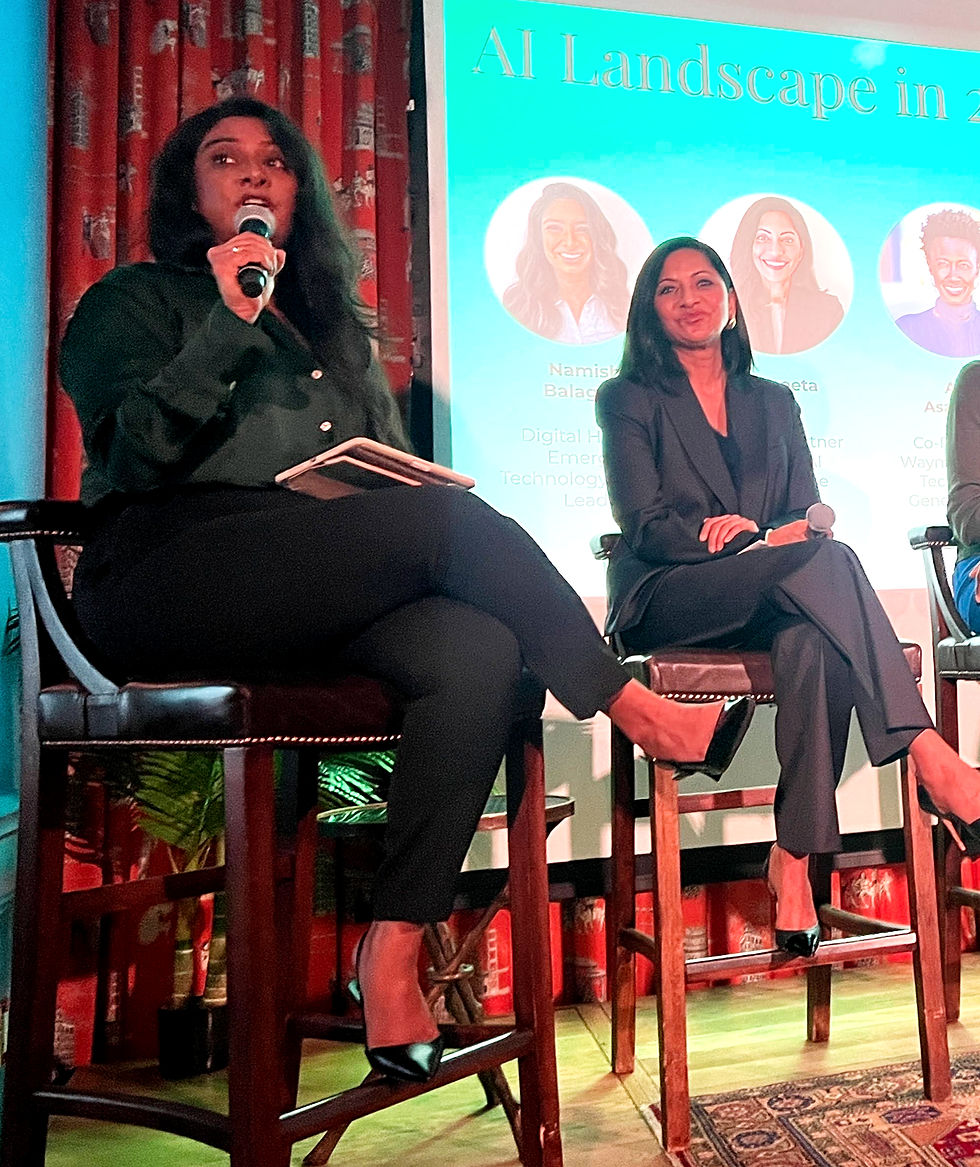
We also discussed the gender dimension. Women remain underrepresented in AI-building rooms. Layoffs have disproportionately impacted female-dominated functions. Yet awareness is increasing.
And here’s what matters:
Community accelerates capability.
It changes who sees themselves as builders, not just adopters.
What 2026 Will Reward
2026 will not reward hype. It will reward:
Infrastructure thinking
Governance maturity
Cultural readiness
Operational trust
Responsible execution
The question is no longer whether to adopt AI.
The question is whether your organization is structurally prepared for it.
And that is a leadership decision.


Comments