
Beyond the Breakthrough: Scaling Enterprise AI and Driving ROI at The AI Rabbit Hole 2026

Updated: Jun 26
Written by Jenny Kay Pollock, Co-Founder and Co-CEO of WOMEN x AI (WxAI) and Founder of Luminizing Growth. Through her work with executives, founders, and AI practitioners, she helps organizations navigate AI-driven transformation and adoption.
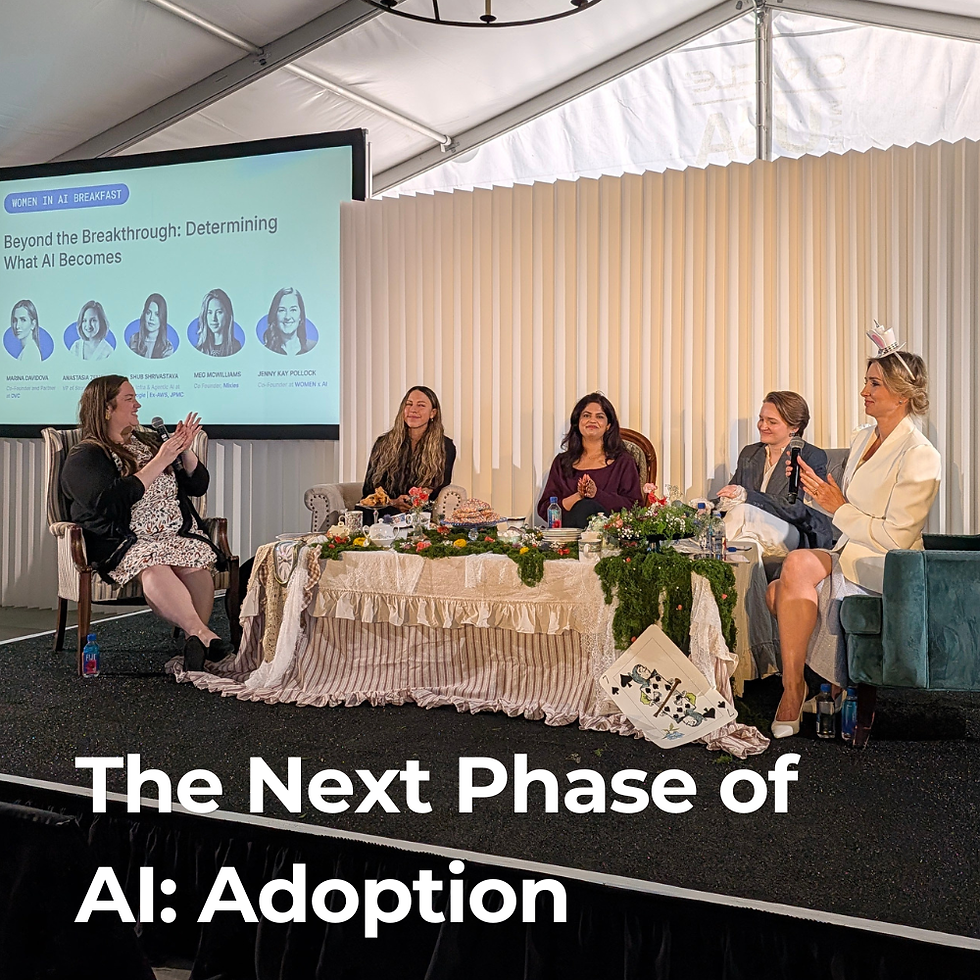
For the past few years, much of the AI conversation has centered on new models, benchmark results, and breakthrough capabilities. But as I listened to the panelists and spoke with attendees throughout the day, it became clear that many leaders have moved on to a different set of questions:
How do I get the most out of AI?
How do I help my team adopt AI?
Am I falling behind?
How can AI improve my business?
How can AI help me do more?
They are no longer asking what AI can do. They are asking how to deploy it, govern it, scale it, and generate meaningful business value from it.
That shift became the foundation of our Women in AI breakfast session at The AI Rabbit Hole: AI Bubble Tea Party, the premier invite-only conference hosted by MadHats AI.
The panel, titled "Beyond the Breakthrough: Determining What AI Becomes," brought together leaders across venture capital, developer tooling, cloud infrastructure, and consumer applications to discuss the next phase of AI adoption.

As moderator of the session, I had the unique opportunity to hear how leaders across these different domains are thinking about the future. While their perspectives differed significantly, an interesting pattern emerged: almost nobody was talking about model capabilities alone. Instead, the conversation repeatedly returned to implementation, operational readiness, governance, trust, and business outcomes.
How the Conversation Has Changed
One thing that stood out to me as a moderator was how much the conversation has evolved over the past two years.
In 2024 and early 2025, many audiences were still asking a fundamental question:"Do I need to learn about AI?" Today, the question is very different.
Two years ago, people were asking whether they needed to learn AI. Today, they're asking how to help their teams learn AI.
Leaders are trying to help their teams learn. Organizations are trying to operationalize AI. Executives are looking for ways to drive measurable ROI. The conversation has shifted from awareness to adoption.
That shift was reflected throughout the panel. While the speakers represented venture capital, developer tooling, cloud infrastructure, and consumer applications, they repeatedly returned to the same challenge: how do organizations successfully implement AI in the real world?
The answer, unsurprisingly, extends far beyond the technology itself.
The Realities of Scaling Enterprise AI and Driving ROI
The room at the MadHats AI breakfast was filled with builders, founders, investors, operators, and practitioners grappling with similar questions:
How do we get the most out of AI?
How do we help our teams adopt AI?
How do we know if we're falling behind?
How do we turn experimentation into measurable business value?
Despite coming from different industries and levels of technical expertise, attendees were wrestling with many of the same challenges. The consensus was organizations need better systems, stronger implementation strategies, and greater organizational readiness.
Strategic AI Insights from the Front Lines

1. Distinguishing Infrastructure from Hype (Marina Davidova, General Partner, DVC)
As Marina Davidova put it:
"We need trust at each layer of AI."
Her observation extended far beyond the model itself. Trust must exist across the training data, fine-tuning process, infrastructure, governance frameworks, and operational systems surrounding AI.
As organizations move from experimentation to deployment, confidence in the entire stack becomes just as important as confidence in the model itself.
2. Shifting the Developer Workflow (Anastasia Zemskova, VP Strategy, JetBrains)
JetBrains operates directly at the builder layer of software development.
“The most underestimated shift in software development isn’t what AI can generate — it’s that developers now carry full accountability for code they didn’t write. Organizations that don’t build infrastructure to support that accountability will find AI creates risk faster than it creates value” - Anastasia Zemskova, VP Strategy, JetBrains
Anastasia highlighted how deeply integrated AI tools are transforming the day-to-day realities of engineers. The focus is rapidly shifting away from rote syntax generation and moving toward system architecture, code verification, and supervising AI-driven changes.
3. Realizing Enterprise Agentic AI (Shub Shrivastava, Staff Customer Engineer - AI/ML Specialist, Google Cloud)
Moving an AI system from an impressive internal prototype to a hardened enterprise deployment requires significantly more than technical capability.
Shub Shrivastava outlined the hidden operational layers required to make enterprise AI successful, emphasizing the importance of governance, privacy, evaluation frameworks, and deployment discipline.
Organizations consistently underestimate the complexity required to operationalize AI at scale.
4. Architecting AI for Human Connection (Meg McWilliams, Founder & COO, Mixies)
Meg McWilliams challenged the audience to think differently about the role of AI in society.
"If we keep building technology that separates us, that's a sad outcome. I believe AI should be used to help people connect." - Meg McWilliams, Founder & CEO, Mixies
Her perspective stood out because it pushed beyond productivity and automation.
While much of the industry focuses on efficiency gains, she highlighted the opportunity to use AI to facilitate meaningful human relationships, reduce friction, and strengthen communities.
If You Only Remember 5 Things from The AI Rabbit Hole
|
Want more Silicon Valley Event Takeaways? Check out our recent post: What We Learned from 500+ Conversations at Snowflake Summit 2026
What Surprised Me Most

What surprised me most was how little time the panel spent discussing frontier models themselves.
Despite representing different parts of the AI ecosystem, the speakers consistently focused on deployment, infrastructure, governance, workflow integration, and adoption.
The conversation reflected the broader shift happening across the industry of the questions transforming from what AI could do to how to actually use it at scale.
Today, leaders are increasingly asking how to make AI work reliably inside organizations and how to translate technical capability into measurable business outcomes.
The Question About the Next Generation
One audience question sparked a particularly thoughtful discussion.
An attendee wondered whether AI might be the first major technology wave that younger generations seemed hesitant to embrace.
Drawing on conversations I've had while speaking at campuses such as Stanford and De Anza College, I shared a different perspective. In my experience, students are not disengaged from AI. If anything, they are paying very close attention. What many are struggling with is uncertainty.
They are entering a job market that feels increasingly competitive while simultaneously hearing that AI may reshape many of the entry-level roles that traditionally helped people launch their careers. The question isn't whether they care about AI. It's what AI means for their future.
The audience responded with a noticeable sense of empathy. While much of the AI conversation focuses on innovation and opportunity, this moment reminded us that technological transformation also creates real questions about careers, identity, and what comes next for the next generation of workers.
What This Means for the Future of AI
What struck me most was not any individual panelist's perspective but how consistently the same themes surfaced across very different domains.
The venture capitalist talked about trust.
The developer tooling leader talked about workflow transformation.
The cloud infrastructure expert talked about operational readiness.
The founder talked about human connection.
On the surface, these seem like very different conversations. Underneath them was the same challenge:
Organizations are no longer asking whether AI matters. They are asking how to integrate it successfully into existing systems, teams, and workflows.
That question has surfaced repeatedly across WOMEN x AI events, executive workshops, AI Advantage cohorts, and community discussions over the past year.
Whether someone is a founder, engineer, executive, investor, or board member, the conversation is shifting in the same direction.
The AI industry spent the last few years focused on AI capability. The next phase will be defined by AI adoption.
Who Gets to Shape the Future of AI?

One of the moments that stayed with me happened after the panel concluded.
I found myself speaking with a woman navigating a career transition, a philosopher thinking about the societal implications of AI, and an engineer focused on AI implementation. They came from completely different backgrounds, yet all three were wrestling with the same fundamental question: What comes next, and how can we help shape it?
That conversation captured something important about this moment in AI. People are no longer debating whether AI matters. They are trying to understand how to participate in its future.
If there was one idea I hope attendees carried with them after the session, it was this:
More people should have a voice in determining what AI becomes.
The future of AI should not be determined solely by researchers, executives, investors, or technology companies. It should also be shaped by practitioners, educators, students, community leaders, and the people whose lives and careers will be affected by these technologies every day.
That belief sits at the heart of WOMEN x AI. Because the future of AI will not be built by a handful of people. It should be shaped by all of us.
Scenes from the AI Rabbit Hole

The AI Rabbit Hole brought together founders, researchers, investors, operators, and builders exploring what comes next for AI.
The conversations extended far beyond any single session, spanning enterprise adoption, developer tooling, infrastructure, entrepreneurship, and the future of work.
One of the featured speakers was Marina Mogilko, entrepreneur, educator, and creator of Silicon Valley Girl.
Her presence reflected a broader theme that surfaced throughout the event: AI is not just changing technology. It's changing how people learn, build businesses, create content, and navigate their careers.
AI Rabbit Hole made one thing clear: the builder energy around AI is real.

Founders showed up across the event, from the stage to the audience to the conversations happening between sessions.
We saw that same energy at the Nebius booth, where founders were deep in conversation about what it takes to move from idea to prototype, and from prototype to production. For WxAI, that stood out. The future of AI is not just being discussed. It is being built.
Want more insights from the AI Rabbit Hole? Check out Div Manickam's recent post AI Frontier: Balancing Individual Creativity with Enterprise Control
Join the Conversation
Are you navigating the complex transition from AI concept to production?
Join a community of technical women and allies who are helping shape the future of AI through learning, leadership, mentorship, and meaningful connection.

Greetings everyone. Needing to go outside after FUE made me search for a clear rule on hats rather than guessing. The guide at https://hairtransplantcentretoronto.com/can-you-wear-a-hat-after-a-hair-transplant-complete-guide/ lays out a simple timeline: no hats at all for the first three days while grafts are still settling, only loose soft options from about day four to seven, most soft hats okay in the second week if they are not tight, and normal headwear after two weeks. Pressure or friction too early can dislodge grafts. Practical recovery detail from Hair Transplant Centre Toronto.