
What Investors Were Listening For


Written by Jenny Kay Pollock, Co-Founder and Co-CEO of WOMEN x AI (WxAI) and Founder of Luminizing Growth. Through her work with executives, founders, and AI practitioners, she helps organizations navigate AI-driven transformation and adoption.
A good startup pitch night shouldn’t just tell a founder whether investors liked the idea.
It should help them understand:
🎯 What landed?
❓ What created questions?
✏️ Where does the story need to get sharper?
🚀 What might you want to change before your next investor conversation?
The best startup pitch feedback doesn’t simply tell a founder whether investors liked the company. It shows them where conviction increased and where questions remained.
That was what we wanted to create at our recent Pitch Night, co-hosted with Sisters Female Founders and WOMEN x AI.
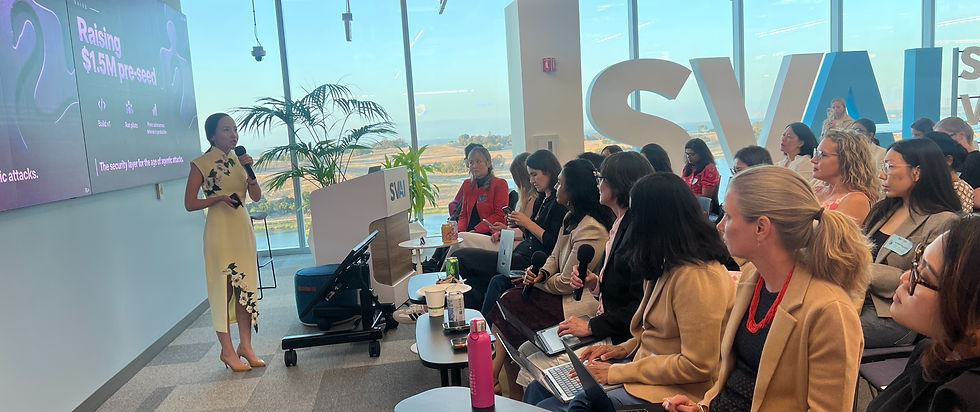
Eight founders took the stage, each bringing a different company, perspective and level of pitching experience. Some were newer to pitching. Others had done it many times before. Some were already generating revenue, while others were still proving out their market.
What they had in common was a willingness to put their companies in front of a room full of investors, founders and community members and invite real questions.
The founders who took the stage
🎤 Dara Tumenbayeva — AORA
🎤 Savita Kini — Kedara
🎤 Xiaoran Wang — AGIGA AI
The companies represented different markets, business models and stages, which made the conversations following each founder pitch especially interesting.
The investors listening closely
Our judging panel included AJ Thomas, Niki Gastinel, Holly Uber, Radhika Iyengar, Vandana Sunkara, Monique Barbanson and Ella Shukho.
One of my favorite things to watch during the night was how seriously the judges took the responsibility.
They weren’t casually listening and deciding whether they “liked” a company.
They were taking notes. Asking follow-up questions. Filling out the feedback form for each founder. Looking for the pieces of the business that were already compelling and the places where another conversation would likely go deeper.
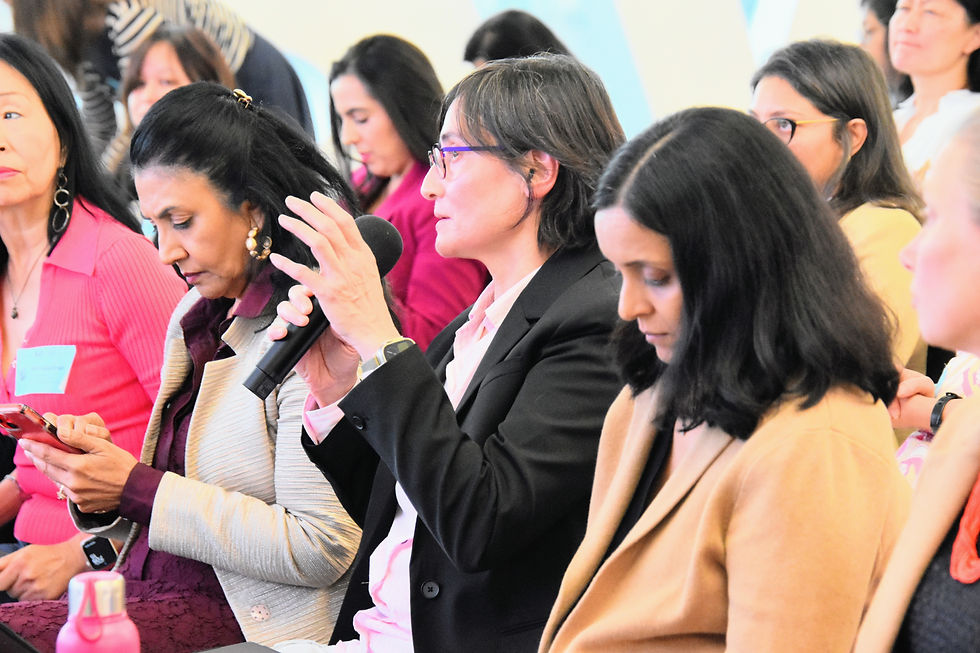
Because the goal wasn’t simply exposure. We wanted to provide real feedback, because feedback can be as valuable as exposure.
What do investors look for in a startup pitch?
A pitch is only a few minutes long, but investors are processing a remarkable amount of information during that time.
Our judges focused on areas including:
Problem and solution: Is the problem important and clearly defined? Does the solution make sense for it?
Why now and why AI: Is there a compelling reason this company should exist now? Where AI is part of the product, is it meaningful to the value proposition rather than simply part of the pitch?
Market opportunity: Who is the initial customer? How large could the opportunity become?
Traction and validation: What evidence shows that customers want this? Are people using it, paying for it, piloting it or asking for more?
Business model: How does the company make money, and can that model scale?
Competitive advantage: What makes this company meaningfully different? What becomes difficult for another company to replicate?
Team: Why is this the team to solve this problem?
The ask: What does the founder need next, and is that ask connected to the stage of the business?
And underneath all of those questions were three deceptively simple ones:
Why this problem? Why now? Why this founder?
The startup pitch feedback themes we heard
Every company received its own individualized feedback, and we won’t be sharing anyone’s scores, rankings or private comments.
But looking across the feedback, several themes came up repeatedly that are useful well beyond one pitch night.
1. Get very specific about your first customer
A large market is exciting. But investors still want to understand where you start.
Who feels the pain most acutely? Who makes the buying decision? Who is willing to pay first?
Being able to describe the eventual market is different from being able to articulate the wedge that gets you into it.
2. Show what your traction actually proves
Revenue, pilots, customers and growth all matter. But the next question is often: What does this traction prove?
Does it demonstrate willingness to pay? Repeatability? Customer pull? A viable acquisition motion?
The strongest traction story connects the numbers to what you are learning about the business.
3. Explain what makes your startup defensible

Especially in AI, features can become easier to replicate.
Investors wanted to understand what creates lasting advantage: proprietary data, distribution, workflow integration, domain expertise, customer relationships, technology, network effects or something else entirely.
In other words: Why will this get stronger as you grow?
4. Make your go-to-market strategy feel repeatable
Getting the first few customers is important. The next question is how you get the next 10, 100 or 1,000.
Founders don’t need every answer at an early stage, but showing that you’re learning which acquisition channels, buyer profiles and sales motions work makes the growth story much more concrete.
5. Make the pitch easy to understand
A founder may understand every nuance of their company. The audience does not.

Some of the most useful startup pitch feedback isn’t about changing the company at all. It’s about making the company easier to understand.
What can be simplified?
What deserves another 30 seconds?
What can disappear from the pitch entirely?
That is a gift founders can take directly into the next investor conversation.
And then the pitches ended
Another part of the night began. People walked up to the founders.
They asked more questions. Shared insights. Made introductions.
Members of WOMEN x AI and Sisters Female Founders found one another, made new connections and kept the conversations going well after the pitches ended.
People were really listening.
A strong founder community shouldn’t only cheer when someone gets on stage. It should create the conditions for that founder to leave the room with more information, more relationships and a clearer understanding of what to do next.
That’s the kind of room we're going to keep building.

To every founder who pitched: thank you for trusting this community with what you’re building.
To our judges: thank you for listening closely and giving founders feedback they can actually use.
And to Sisters Female Founders, our co-host and partner for the evening, thank you for helping us curate a room where founders could be celebrated, challenged and supported at the same time.
Want to be in the room next time? Join the WOMEN x AI community to hear about upcoming founder events, workshops and opportunities to take the mic.

Comments