
From AI-Curious to AI-Confident: Inside Our Online AI Leadership Cohort for Women

Updated: Oct 12
How 30 executive women applied AI to real professional challenges through the WOMEN x AI Advantage Spring 2026 Cohort.
By Jenny Kay Pollock, Co-Founder and Co-CEO of WOMEN x AI.
Program Contributors: Reut Lazo and Jenny Kay Pollock Lead Facilitators, and Rachel Wong, Principal Learning Architect and Cohort Facilitator.
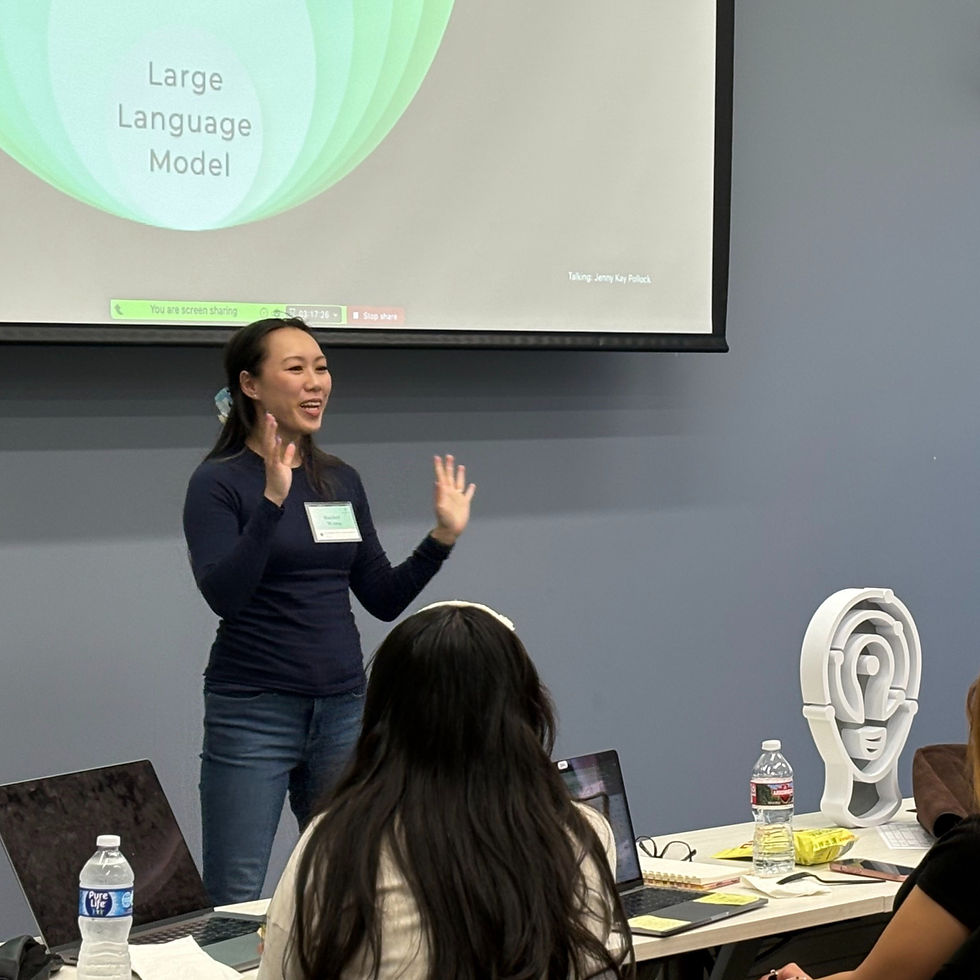
AI confidence does not come from memorizing more tools or collecting more prompts.
It comes from applying AI to real work, learning what happens when the output falls short, and developing the judgment to try again.
Over five weeks, 30 executive women turned real professional challenges into working dashboards, research systems, websites, articles, training materials, and new business offerings.
That belief shaped the AI Advantage Spring 2026 Cohort (Online), a five-week live learning experience created by WOMEN x AI to help women leaders move from AI-curious to AI-confident.
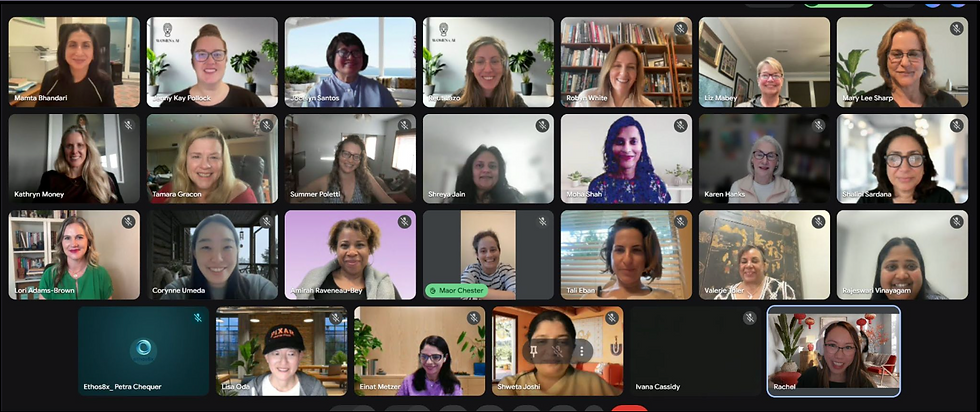
Thirty executive women from across the United States completed the program, connecting leaders from Palm Springs and the San Francisco Bay Area to Minneapolis and Boston met weekly.
The cohort included engineers, operators, healthcare leaders, founders, VCs, board members, strategists, and community leaders with different levels of AI experience. What they shared was a desire to move from observing AI to applying it in their own work.
The program was led by WOMEN x AI Co-Founders Jenny Kay Pollock and Reut Lazo, with Rachel Wong serving as Principal Learning Architect and Cohort Facilitator. Rachel designed the five-week learning journey and helped facilitate the live experience, combining practical application, peer learning, and reflection.
The cohort was sponsored by Veratempo, whose support helped WOMEN x AI create an applied, community-centered learning experience for women leaders.
What Is AI Advantage?

AI Advantage is a five-week, live online program that helps women leaders build the confidence and judgment to apply AI to real professional work. Graduates learn through hands-on practice, peer feedback, expert perspectives, and an individual capstone project connected to their professional goals.
No technical background is required. The program is designed for women leaders who have begun exploring tools such as ChatGPT but want to move beyond basic use and develop stronger judgment, confidence, and practical application.
AI Advantage Spring 2026 at a Glance30 executive women graduated 5 weeks of live online learning Nationwide cohort from Palm Springs and the Bay Area to Minneapolis and Boston 100% completed an applied capstone project 94% described themselves as confident in their ability to use AI at work Sponsored by Veratempo |
Survey findings are based on responses from 17 of the 30 graduates who completed the end-of-cohort survey.
Confidence Through Application
The AI Advantage was designed as a practice-based program, not a passive course.
Participants explored tools including ChatGPT, Claude, Gemini, Perplexity, NotebookLM, and Lovable. But the goal was never to teach a fixed list of platforms. AI tools will continue to change.
The more durable goal was to help leaders explore new tools, evaluate their outputs, and decide where AI could create meaningful value in their work.
Each week combined live instruction, hands-on practice, breakout conversations, peer feedback, and progress on an individual capstone project. The curriculum moved from personal AI workspaces and authentic prompting to professional positioning, opportunity research, responsible adoption, and real-world AI applications.
The capstone gave every participant the opportunity to apply what she was learning to something useful in her actual work. The goal was not perfection. It was a tangible win that could build confidence through application.
By the end of the cohort:
94% described themselves as confident in their ability to use AI at work.
88% said they had a safe, trusted community where they could ask questions about AI.
82% were using AI weekly or daily for multiple or core work tasks.
Learning AI in Community
Technical confidence is only part of the AI Advantage.
AI conversations can make even experienced leaders feel as though everyone else knows more than they do. That feeling can keep people from asking questions, testing unfamiliar tools, or acknowledging uncertainty. The cohort was designed to replace that pressure with curiosity.
Every session opened with the WOMEN x AI Promise:

The promise established a learning environment where expertise was shared rather than performed. Participants could ask basic questions, challenge outputs, compare approaches, and learn from women applying AI in entirely different contexts.
The geography of the cohort made that exchange even richer. Summer Poletti joined from Palm Springs, Deb Haas from Minneapolis, and Moha Shah from Boston, alongside participants from the Bay Area and communities across the country.
Different industries and locations created different perspectives on the same technology. Participants learned not only from the curriculum, but also from how other women were experimenting, questioning, and building.
As one graduate reflected:
“The class created space for me to expand my understanding of AI’s purpose beyond just getting small things done faster to re-thinking how to approach the big things altogether.”
— Liz Mabey, Community Engagement Associate, How Women Lead
Learning From Women Putting AI Into Practice

During Week 4, participants moved beyond individual tools to examine how AI is being implemented across industries and leadership roles.
Moderated by Kate Carter, the session brought together leaders working across AI governance, enterprise transformation, conversational AI, product strategy, and founder readiness.
Kate, a doctoral candidate working at the intersection of AI and healthcare, public speaker, and advocate for greater diversity in technology, guided the discussion and helped connect the panelists’ perspectives to the questions participants were exploring throughout the cohort.
The panel featured:
Anna Jacobi, VP of Product and Strategy, who explored the governance layer needed to support AI infrastructure.
Anita Gardyne, an AI and coaching founder, who discussed the path from pilots and early products to market and enterprise readiness.
Saritha Vrittamani, an AI transformation leader at PwC, who shared an enterprise perspective on organizational change.
Shweta Joshi, a Senior Solution Architect specializing in conversational AI, who brought a technical and implementation-focused perspective.
The panel became one of the most frequently mentioned sessions in the final survey. Graduates valued hearing how leaders outside their immediate networks were approaching governance, adoption, strategy, and experimentation.
Moha Shah described it as an opportunity to see how AI leaders across industries were incorporating new practices, strategies, and tools into their workplaces and personal projects.
From Ideas to Tangible Work
Graduates applied AI across six broad areas: product development, career strategy, research, decision support, content creation, and professional education.
Each woman selected a real professional challenge and used AI to make meaningful progress.
Building Products and Digital Experiences
Raji Vinayagam created Saha, an emotional-clarity companion built with Lovable. Her goal evolved from simply building something to exploring how the product could create real value through partnerships.
Robyn White used Lovable and Claude to rebuild her portfolio website through vibe coding, turning a long-delayed project into a working digital experience.
Joy Santos used Lovable in combination with Claude, Perplexity and Gemini to create a beautiful personal portfolio website.

Annie Deihl created a functioning news-summary application and began exploring how an AI agent could help filter content and support ongoing competitive research.
Mamta Bhandari built a public dashboard tracking implementation of California’s Phone-Free School Act. Her initial project researched and scored 57 school districts across 20 counties, covering 214 high schools, with plans to expand across California and eventually nationwide.
Shreya Jain began developing a CFO intelligence dashboard using Claude and Perplexity.
Lisa Oda challenged herself to ship a branded tutorial about creating a custom GPT before the cohort ended. Her project combined AI assistance with human judgment and creative direction.
Mary Lee Sharp created a custom script, image, presentation, and video for a leadership training program. She left with a repeatable process for producing just-in-time learning materials.
Summer Poletti used the cohort to develop a workshop addressing a recurring challenge faced by scaling leaders. The capstone helped her move forward on an idea she had been considering for more than a year.
The Capstone Was a Deadline and a Doorway

For many graduates, the capstone created the structure and accountability needed to turn an idea into something tangible.
It created a deadline, but it also created permission and urgency to try.
Graduates shared working prototypes, research processes, dashboards, content, and new professional offerings. They saw what other women had built in five weeks and left with a broader sense of what they could create next.
As Annie Deihl put it:
“The capstone made me do it, no matter what!”
Shalini Sardana said the experience removed a mental block around vibe coding and opened her mind to the range of applications demonstrated by the cohort.
The final presentations reinforced one of the program’s core lessons: confidence is not the absence of uncertainty. It is the willingness to experiment, assess the result, and keep building.
What Graduates Said
“This cohort doesn’t just teach AI. It builds a mindset of continuous learning, experimentation, and real-world impact.”
— Raji Vinayagam, Principal Engineer at Cisco
“A great course that opens your mind to AI and its application in a safe and supportive setting for women who often feel overwhelmed when it comes to the application of AI.”
— Shalini Sardana, Co-Founder and Co-CEO, She Raises Capital
“Wherever you are in your AI journey, you’ll get something out of this cohort. Highly recommend.”
— Summer Poletti, Founder and CRO at Rise of Us and Producer and Host of Revenue Remix
“WOMEN x AI gave me the tools to go from curious to capable and confident. As a registered nurse turned pharmacovigilance leader, I came in knowing my domain. I left knowing how to use AI strategically within it.”
— Valerie Toler
Recognizing the People Behind the Program
The AI Advantage Cohort was built and facilitated by women committed to making AI education practical, relevant, and accessible to leaders. Reut and Jenny, Co-Founders of WOMEN x AI, served as lead facilitators.
Rachel Wong, Principal Learning Architect and Cohort Facilitator, designed the five-week learning journey and helped guide participants through practice, reflection, peer learning, and application.
We're grateful to Kate Carter for moderating the Week 4 industry panel, to each of the panelists who shared their expertise, and to Veratempo for sponsoring this cohort.
Most importantly, we celebrate the 30 women who showed up with curiosity, shared what they knew, asked questions when they did not, supported one another, and completed the program.
The Real AI Advantage
By the end of the program, graduates had produced websites, dashboards, articles, research systems, applications, training materials, videos, and new professional offerings.
But the most important outcome was not a specific artifact. It was the ability to say:
I do not need permission to use AI. I know how to explore, evaluate, and apply it myself.
That is the AI Advantage.
The Next AI Advantage Cohort
The next online AI Advantage cohort begins September 11, 2026.
The five-week program will again combine live instruction, practical experimentation, peer learning, expert perspectives, and an applied capstone connected to each participant’s professional work.
No technical background is required.
Supporting Future Cohorts
AI Advantage was made possible in part through the support of sponsors like Veratempo.
WOMEN x AI works with organizations that want to expand practical AI learning and leadership opportunities for women. If your organization is interested in supporting a future cohort reach out to Jenny at jenny@womenxai.com


