
A Revenue Strategist's Playbook From TechCon SoCal

By Summer Poletti, Founder and CRO of Rise of Us, Host of Revenue Remix podcast and frequent WOMEN x AI (WxAI) speaker.

The Room Before the Panel Started
I walked into Templo Mayor Hall at San Diego State University's campus on a Saturday afternoon with my exec assistant, who everyone noticed “happens” to look exactly like me. Right down to the colorful highlights. We were, as several people pointed out, a walking billboard. Before I could even find my spot, I ran into Kimberly and Taylor, another mother-daughter team building their future at TechCon. They just launched Preflight AI, a smart AI readiness tool.
I had been messaging Kim on LinkedIn for several months and the stars finally aligned and put us at an event together. We had connected before the event specifically to find each other, and there we were, two mother-daughter pairs walking into a women-led panel together about the future of talent and growth in the AI age, at a university full of students stepping into the most disrupted workforce in a generation.
The security guard directing people to our room mentioned with quiet pride that this was one of only two women-only panels at TechCon SoCal. At an event that sprawling, across multiple floors of SDSU's campus, representing fintech, healthtech, deeptech, AI, mobility, patient care, talent strategy and more, that felt worth noting.
Energizing moments like this, before the discussion even starts, only happen when events are done right.
If You Only Remember Three Things:
|
Before Any of That: The Prep That Made It Possible
TechCon SoCal is not a small event. Founders, investors, operators, media, students. Industries ranging from AI and automation to mobility to how artificial intelligence is changing patient care, and much more. The sheer variety of people and conversations meant that walking in without a filter wasn't a strategy, it was a recipe for expensive overwhelm.
About two weeks before the event I opened my Claude project, trained on my revenue strategy and ICP, and put it to work. I gave it publicly available information about speakers, attendees, and media and asked it to identify high-potential collaborators and tell me why. Not everyone at a conference is someone I need to talk to. The diversity of TechCon made precision critical.

Claude surfaced about 20 people worth reaching out to. But here's where the human layer matters: I didn't automate the outreach. I normally use Expandi for sequenced outreach campaigns, but I set it aside entirely for this. These are visible, accomplished people who receive a lot of messages. They can smell spray and pray a mile away.
I wrote every single outreach note myself, personally, with a specific reason for reaching out to each person. Twenty messages I could write well. Two hundred I could not. That's the point.
Eight people responded before the event. I set up meetups and coffee chats during the event week before I ever arrived. And two of my strongest post-event connections were people the AI didn't flag at all. I found them in the room. Human review is just as important as human-led.
What WOMEN x AI Curated and Why It Worked

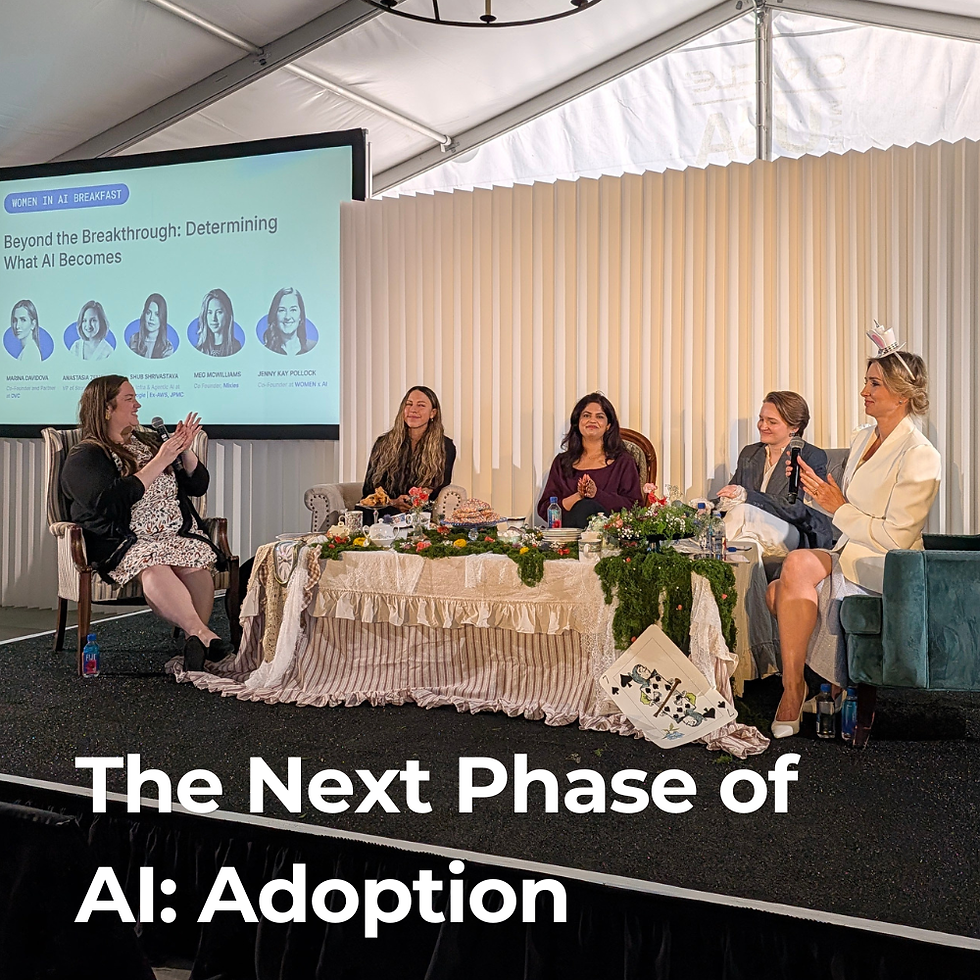
The panel WOMEN x AI curated for TechCon SoCal 2026 was titled Rethinking Growth, Talent, and Discovery in the Age of AI. Four panelists, with four distinct lenses:
 |  |  |  |
Alicia Shapiro, CMO of AI News, bringing the media and discovery perspective | Lolita Taub, Founder and General Partner at Ganas Ventures, bringing the investor view. She's the author of the forthcoming book, "What Matters?" | Ajantha Suriyanarayanan, Founder and CEO of MentalLoad AI, bringing the founder and human behavior lens. | Summer Poletti, Founder and CRO of Rise of Us, moderating as a growth strategist whose work lives at the intersection of revenue, systems, and the humans who execute both. |
The panel curation was intentional and it showed. Forty minutes for a panel is generous by tech event standards, and WOMEN x AI used it well. The conversation moved across talent, cognitive load, discovery in an AI-first world, what investors are actually looking for right now versus a year ago, and what founders are still over-investing in. My job as moderator wasn't to traffic-cop questions. It was to weave those four perspectives into something coherent, to find the thread connecting an investor's thesis to a founder's lived experience to a media executive's view of how discovery itself is being redefined. The panel left the audience wanting more. And that is exactly what it was supposed to do.
The Question I Planted

Here's something I don't usually say out loud but I will here because this audience will appreciate it: I planted a question in the audience specifically for the Q&A portion.
I knew there were students in the room; we were on a university campus. And I suspected, from my own conversations and observations, that a panel of people who have already built careers, funds, companies, and “made it” was unlikely to naturally turn toward the view from the bottom of the ladder. The people just entering the workforce. The ones watching entry-level jobs disappear at a pace we have never seen before.
So I asked my exec assistant, Liliana, who is in college and was working the event with me, to ask the question I knew needed to be in the room, “ AI is replacing entry level jobs. Everyone says you need an expert in charge of setting up and reviewing AI, but if no one is hiring recent grads, where are those experts going to come from 10 years from now?”
She asked the question (which is when people also noticed she carries my mannerisms), the panel answered it. All of us weighed in. And then she told me afterward that we didn’t really land the plane. The panel didn't entirely grasp the magnitude of the panic in her generation about what AI means for their future.
That question is also what brought two HR tech leaders from the audience straight to me after the panel ended. They weren't done and neither was I.
Since even Hollywood producers would be hard-pressed to write such a natural setup for a sequel, both of them are coming on my show, Revenue Remix, for TechCon SoCal Part 2. Or is this Fan Fic?
Strategic conversation architecture doesn't only happen before and after events. It happens during them too.
The Follow-Up System That Turns Events Into ROI
Here's where most people leave money on the table.
It's easy to get swept up in event energy, collect a stack of business cards or LinkedIn connections, feel genuinely inspired, and then open your inbox Monday morning and let the momentum die. The event hype fades. Your calendar fills back up. And two weeks later you're trying to reconnect with someone based on a note you scribbled in your phone that says "tall guy, fintech, interesting."
I do it differently.
First, I protect my post event calendar. I blocked off the 3 business days following my return from the event so I would not come back to a full calendar.
During event week, I scheduled follow-up meetings on the spot (most were able to slot into those protected days). Not "I'll send you my scheduling link and you can find a spot." I pulled out my phone, we found a time, we booked it. Face to face, in the moment, while the energy was still alive. I use Calendly and Wix for scheduling tools but I don't rely on them when I'm standing in front of someone. The personal handoff is part of the signal.
Before I left the event I also identified the people I had wanted to connect with but missed in the chaos of a multi-floor, multi-track conference. I followed up with those people immediately, while TechCon was still trending in the feed and the shared experience was still fresh.
And in the 3 days following my return, I had all the follow up meetings, and got everyone into my flywheel. Because here is the truth about that window: it is short.
If you try to strike up a meaningful conversation with someone two years after an event, I promise you they do not remember meeting you, no matter what note you wrote in your CRM.
The magic of an in-person event is the shared moment of being in the same room. The follow-up is how you convert that moment into something real.
What's Compounding Two Weeks Out
Ten high-potential relationships are actively moving through my process. Six follow-up panels and interviews are already scheduled, with more in the works. I’ve plugged 3 people into the Q3 panels I had already planned for Revenue Remix. And I’ve introduced 6 of them to people in my network they should know.
It’s not just about my podcast, Revenue Remix is my partnership magnet because lead magnets don’t work any more. It’s helpful to give people a reason they would want to talk to you.
The Human Side of AI Adoption
I can't write about TechCon SoCal without naming the thing that's been rattling around in my head since I left.
We were at a major research university. Bright young students everywhere, the next generation of leaders, stepping into a workforce in genuine upheaval. Entry-level jobs are disappearing at a pace we have never seen. The ship will right itself eventually. But try telling that to a 22-year-old with a new degree and $100,000 in debt.
In those same halls, investors and founders were genuinely electrified about AI and automation. Near-magical technologies reshaping the economics of how companies grow. I am not anti-AI. I use it every day. It made this entire event strategy possible.
But I couldn't help noticing the dichotomy.
The Question I'm Still Sitting With
Human-led, ethical AI is at the heart of what WOMEN x AI stands for, I'll leave this community with the questions I don't have answers to yet:
What do healthy, sustainable companies look like in ten years if we don't leave space right now to hire and mentor the next generation of leaders?
What does your revenue look like in two years if unemployment reaches levels where people can no longer afford to buy your product? AI and automation at all costs feels like the other side of the growth at all costs coin we've been flipping for a decade.
The future of work is not coming. It's here. And the most strategic thing leaders can do right now is think beyond the 2026 bottom line.
That conversation is continuing on my channel; I’ve already drafted those young entrepreneurs to help me frame it right.
The Short Version for Founders and Operators
If you're going to invest in in-person events, invest in the full arc:
Before: Use AI to identify high-potential people precisely. Personalize every outreach yourself. Automation is for volume. This isn't volume.
During: Keep your eyes open for the people no algorithm would flag. Schedule follow-up on the spot. Plant the questions the room needs but won't ask itself.
After: Block your calendar. Stay focused. Send targeted intros. Move fast while the window is open.
The event is the seed. Everything else is the harvest.
Summer Poletti is the Founder and Revenue Architect at Rise of Us, a fractional CRO practice for B2B SaaS and fintech companies navigating the transition from founder-led to leadership-led revenue. She hosts Revenue Remix on The Rise of Us podcast. Find her at theriseofus.com.

I help several security firms with their marketing and I’m always looking for fresh strategies that actually work in this niche. In the middle of my research, https://webugol.com/blog/mastering-digital-marketing-for-security-companies-strategies-for-success/ became the resource that stood out. Webugol outlines key tactics such as local SEO, pay-per-click campaigns focused on emergency services, content marketing that builds trust, and using video testimonials effectively. The article feels realistic and avoids generic advice. Several of my clients have already started implementing some of these ideas with good early results.