Inside AI Advantage: Women Shaping How AI Works Across Industries


What happens when you bring together women working in construction, financial services, enterprise technology, and local government to talk about AI?
You hear different perspectives on questions many of us are navigating:
What is actually helping?
Where are we creating more work?
And how can we help shape the changes happening around us?
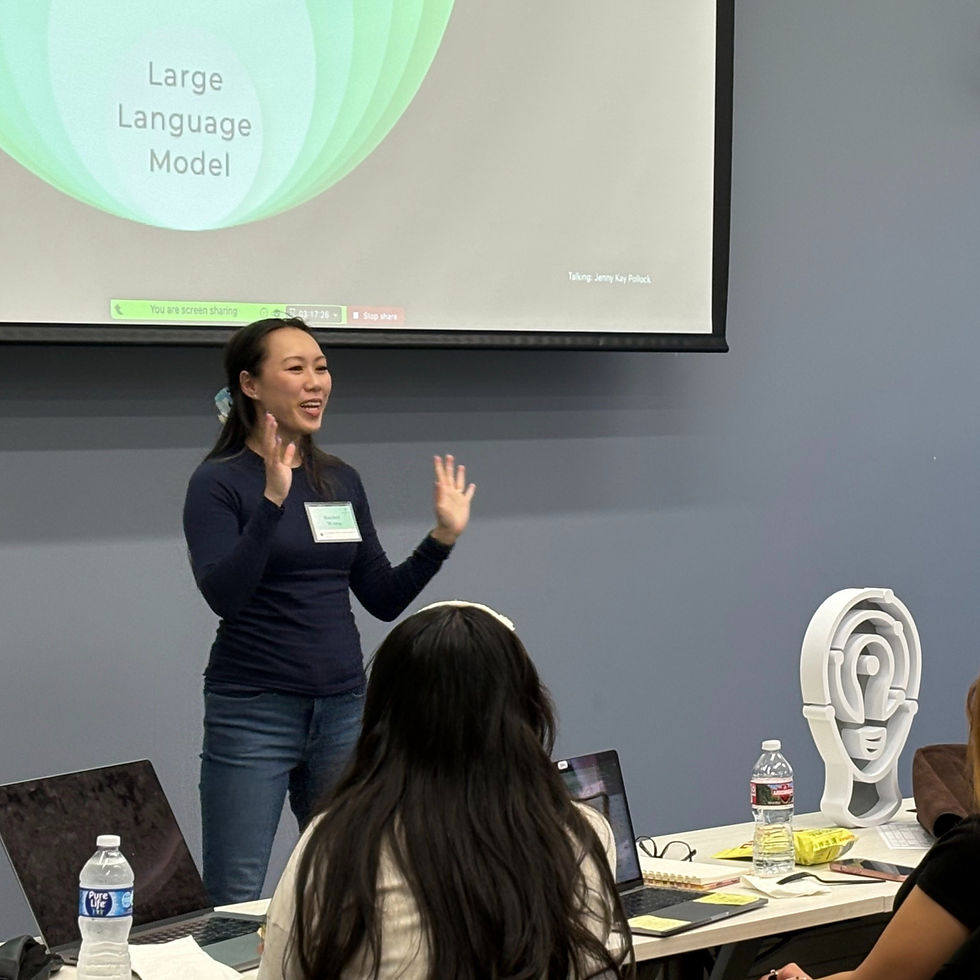
On October 23, 2026, we brought these perspectives together during Week 4 of AI Advantage, WOMEN x AI’s five-week learning cohort. Cofacilitators of the program Jenny Kay Pollock, Reut Lazo and Rachel Wong hosted the session, which combined an industry panel with small-group conversations and capstone project support.

Kate Carter, AI Program Manager for the City of Tucson and doctoral candidate researching AI and healthcare, moderated a conversation with Rachel Roundy, who leads AI PMM at Snowflake; Moha Shah, venture capital leader and innovation operator across AI, mobility, climate, fintech, and insurtech; and Adalia Zhao, founder of Pyramid, building toward autonomy in construction.
Check out ths insights shared by our expert panel.
Start with the outcome people care about
Adalia brought a perspective grounded in construction, where her customers spend their days on job sites and regularly hear pitches for new AI solutions.
They want work taken off their plates. Another platform to learn or dashboard to check can become another responsibility in an already demanding day.
Her experience has led her to think beyond adding AI to existing tasks:
“Redesign your workflow around that instead of like adding up AI on top of every single workflow.” — Adalia Zhao
The starting point is the outcome. For her customers, that might mean finishing the work and getting home to their families earlier. Understanding that priority changes what she builds and how she delivers it.
It’s a useful perspective for anyone introducing AI: how well do you understand the day of the person you’re trying to help?
Keep the customer at the center
Moha brought experience from financial services, corporate innovation, venture capital, and advising AI startups.
She described the practical considerations organizations face as they explore adoption: the state of their data, existing technology, governance, and whether a proposed solution serves a clear business need.
“Make sure that your customer remains at the center of it.” — Moha Shah
A specific use case gives teams something meaningful to evaluate. Did the change improve the customer experience? Reduce costs? Help someone complete important work?
Her perspective reminds us that choosing where AI belongs requires business judgment and an understanding of the people affected. For more From Moha Shah check out AI Governance: Insights for Business Executives and Board Leaders.
Look at where the work goes next
Rachel shared what she is seeing as teams move from experimenting with AI toward understanding which uses create lasting value.
One example resonated: AI can help people write code faster, while reviewing that code still requires attention and time.
“The bottleneck has moved from like the coding piece to the review piece.” — Rachel Roundy
That opens up a broader conversation about productivity. A task getting faster can change the demands on the next person in the process. Review, coordination, and decision-making still need time and recognition.
When evaluating an AI tool, look beyond the time it saves the person using it. Ask what changes for the next person in the workflow.
That question can help teams see whether they are improving the overall process or shifting the workload somewhere else. Continue exploring how executives can evaluate AI tools, including their fit with real business needs.
Help define what success looks like
Kate brought these ideas back to the people whose jobs are changing.
As AI shifts responsibilities, the way organizations measure and recognize contributions may need to change too.
“I hope that you're part of those conversations of shaping how you're measured in terms of success.” — Kate Carter
She encouraged participants to raise these questions before an annual review. If your work increasingly involves reviewing outputs, making decisions, or guiding others, those contributions need to be visible.
Women have experience and perspectives that belong in these conversations. Building familiarity with AI can help us ask informed questions and participate in decisions about how our work evolves. Read Kate Carter’s AI Spotlight to learn more about her journey from healthcare into AI.
Learning from one another and putting it into practice
This is one of the reasons we bring women across industries together at WOMEN x AI.
A construction founder’s experience can spark a new idea for someone in enterprise technology. A question from local government can help an advisor see a challenge differently. Hearing how another woman approaches a decision can give you the confidence to ask your next question.
The panel was one part of the session. Within the cohort, participants continued the conversation in smaller groups, connected their questions to their own work, and received support as they developed their capstone projects.
That combination is central to AI Advantage: learning from women with different experiences and having a community alongside you as you put ideas into practice.
Thank you to Kate, Rachel, Moha, and Adalia for sharing their perspectives so openl and to the women in our cohort for bringing their curiosity, experience, and thoughtful questions. 💜
As AI changes your industry, what is one conversation you want women to help shape?
Inside AI Advantage offers a glimpse into the conversations within WOMEN x AI’s learning cohort. The full experience brings together live learning, hands-on projects, small-group discussions, and support as you build.
Explore our programs and upcoming opportunities at womenxai.com.